Showing posts with label Success Formula. Show all posts

Thursday, July 7, 2011

Failing the Failure Formula

“Failure is not a single, cataclysmic event. You don’t fail overnight. Instead, failure is a few errors in judgment, repeated every day.”
Jim Rohn

You know, it takes more work to fail than to succeed. Failing is a skill. There is a structure to failure and it is encapsulated by the following formula which turns the NLP Success Formula on its head:

The Failure Formula
1.    Ignorance – Don’t know what you want or what’s important to you.
2.    Don’t do anything about it – don’t take congruent action or take inefficient or meaningless action.
3.    Ignore all feedback – don’t learn from experience.
4.    Don’t change – be very inflexible, keep doing what doesn’t work.

It’s really obvious!

It’s obvious really… repeated failure comes from being very skilled in one or more of the steps above. You can easily sabotage success by not knowing what you want, or following poorly-formed outcomes; by not taking action or taking incongruent and ineffectual action; by ignoring feedback or advice; and by being stuck or inflexible and not changing as required. Oh, and remember: make sure you complain and whinge about how cruel life is to make all this happen to you...

The wise aphorism of ‘a stitch in time, saves nine’ expresses quite well the fact that failing creates more work and requires more energy from life. If you are clear on your outcomes and proactively do the ‘stitch in time’ to fix things before they fail, you’ve only invested a small amount of energy to succeed.

However, if you neglect to get clear about what you want and need in life or fail to take action in time, then you’ll end up having to do ‘nine’ times the work to remedy the failure. You will constantly be expending far more energy, time and resources just to get by.

A cool idea…


And here’s a cool idea… If you are skilled at failing, then why not fail at failing? Just stop failing. Fail at following the Failure Formula. Hmmm, obvious really: Turn failure around and do its converse – success.

Yes, failure takes work and is a skilled incompetence. Anytime you find yourself not getting what you want in life, examine your behaviour to see if you’re unconsciously following any of the steps of the Failure Formula. Look for examples of the Failure Formula in your life. Then assiduously and passionately pattern interrupt them and do the converse.

Place your focus and motivation onto the steps of the Success Formula. Get clear about your goals, values, strengths, outcomes and dreams. Prioritise and focus your well-formed outcomes. Take congruent action and follow through. Learn from the feedback life provides as you take action and then change flexibly to keep adjusting your behaviours till you’ve achieved your desired results.

If it’s possible in the world, then it’s possible for you. It’s never a question of ‘if only I could do it’, it’s simply a question of learning ‘how’ to achieve your desired success. Learning comes when you are open to feedback and open to advice. Look for role models – people who have already achieved the results you desire. Then learn from them and model their actions.

Invest in your Self

This life is yours! It’s the life you lead! So lead it well. Your life can be fantastic if you stay strong, stay focused and put action to your dreams.

Invest in your life, your future and your self. Build up your knowledge and skills. Determine your strengths and then build on them. Focus your life. Gain as many and as varied experiences as you can.

Educate yourself. The more you invest in your self and in creating a meaningful life, the more you’ll be able to live great dreams. Life is a wondrous adventure and there is nothing like living an amazing dream to create an amazing future now.

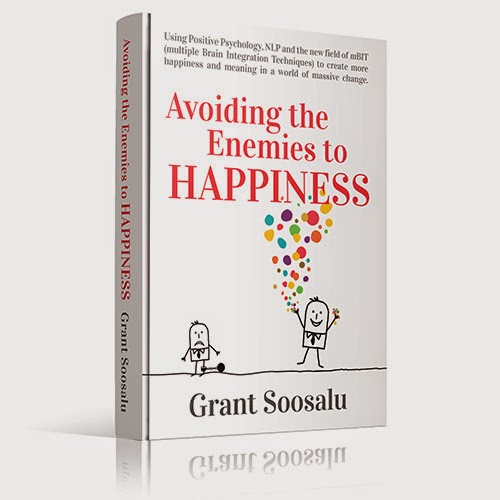
And you can learn more about all of this in my new book: 'Avoiding the Enemies to HAPPINESS'

http://www.ae2h.com

So Take Action! Follow the Success Formula. Be the changes you want to see in your world. Watch out for the Failure Formula in your own life and those around you - Pattern interrupt it whenever you see it. You can do it! You really can make a life enhancing difference!

smiles and life enhancing wishes,
Grant

Sunday, February 6, 2011

Learning from Feedback

“Feedback is the breakfast of champions.”
Ken Blanchard

We discussed the NLP Success Formula in the previous post on Questioning Assumptions. The Success Formula says that to maximise your chance of success you need to operate the following strategy:
  1. Clearly know your Outcome
  2. Take congruent Action
  3. Sensory Acuity – Learn from Feedback
  4. Behavioural Flexibility – Change and adjust to achieve your Outcome

From this strategy comes the insight that there is no such thing as failure, there's only life enhancing, useful and valid feedback. If what you are doing isn’t working or is moving you further from your outcome, then this is really excellent feedback and allows you to use requisite variety to change and adjust your actions ‘til you are moving closer to your outcome. Excellent. There’s no failure, only feedback. What a great thinking tool.

Thinking Tool – Feedback

"No failure, only useful feedback!"


Too often people see negative feedback as failure. They hate hearing or seeing that something isn’t working or that they are wrong. They then go into denial or distort the facts in order to delete such really useful feedback. When you understand there is no failure, there's only fantastic feedback that you can use to support your success strategy, then you empower yourself to accept reality and make positive use of it. The facts really are our friends. They point us in the direction of our happiness and success.

You really do want to know what works and what doesn’t work in the world. You want an accurate and useful map of your world. So value and appreciate all feedback -- it's life enhancing. Learn and grow from it.

life enhancing wishes,
Grant

Monday, January 24, 2011

Questioning Assumptions

"Honesty is the first chapter of the book of wisdom.”
Thomas Jefferson

So much of our model of the world is based on unquestioned assumptions absorbed from our culture, our families and friends. Unquestioned assumptions are life denying when they limit your choices and cause you to repeat patterns that no longer serve you.

A great learning metaphor that demonstrates this is the story of a young woman cooking a roast. She’s about to cut the meat into two, to put into the baking tray when she wonders why she is doing this. She decides to call her mother and ask. Her mother, perplexed by the question, says “I don’t know darling, that’s just the way I was taught. You’ll have to ask your Grandmother”.

The girl calls her Grandmother. “Grandma, how come when I cook a roast I have to cut it in half? Why do I do that?” “Oh darling” says the older woman, “You don’t have to cut it. In fact, it’s better if you don’t, that way the meat won’t dry out as much”. “It all started with your Great Great Grandmother. Back in her day, the stoves and baking dishes were very small. So to fit a roast in the tray you had to cut the meat in half. She taught her daughter that way, who taught my mother that way, who taught me. In turn, that’s what I taught your mother, and she taught you. It’s just the way we’ve always done it. But no, now that you’ve asked, you’re right, you don’t have to do it that way any more”.

This story is so typical of many habits and patterns, many assumptions, we have and do in our life. We learn things from family and society and unless we question the assumptions that these learnings and patterns are based on, we end up doomed to repeat the inefficient and unproductive patterns of the past.

Many practices from the past, especially those embedded in our culture, come from a time of scientific ignorance and superstition. Unless questioned, these practices cause you to metaphorically cut your roast in half. Leading to dried out, shrivelled results in life.

Question everything!!!

It's life enhancing to begin to question everything. All the old patterns and habits in your life. Ask yourself “Why do I do X?” Figure out the purpose and outcomes of your behaviours. Question the assumptions inherent in each of the patterns in your life. Then use the NLP Success Formula below (and described in the blog post on Living your Dreams).

NLP Success Formula:
  1. Clearly know your Outcome – know exactly what you want and ensure your outcome is well-formed, that it’s positive, achievable, believable and ecological.
  2. Take positive Action – congruently and wholeheartedly take action to achieve your outcome.
  3. Learn from Feedback – use your sensory acuity to determine if your actions are moving you closer or further away from your outcome. There’s no such thing as failure, just great feedback, cause if what you are doing is not moving you closer to your outcome then you need to perform the next step –
  4. Flexibility – change and adjust your behaviour (step 2) till you move closer to your outcome.

Apply this to the patterns in your life...

So get clear on your outcome, take new action, use your sensory acuity to learn from feedback and with requisite variety, change and adjust your behaviour flexibly to keep moving closer to your explicit outcome. Throw away old patterns that are a life denying enemy to your happiness and replace them with new patterns that serve you. Be honest with yourself. Question the presuppositions and patterns that form the basis of your life. It is life enhancing to question your assumptions!

Awareness Questions – Questioning Assumptions

Ask Yourself:
  • What is this behaviour or pattern based on? What are the assumptions this action is based on? Why am I doing this?
  • What outcomes and purpose does this pattern achieve? How else can I achieve the positive intent in a more useful and productive way?
  • Does this behaviour still serve me? What else can I do to achieve more life enhancing happiness?

Monday, March 29, 2010

Freedom - part 1

"He is free who knows how to keep in his own hands the power to decide."
Salvador de Madariaga


It is life denying to diminish your world through limited choice and flexibility.

Freedom and choice are important and life enhancing values and you want to hold on to them with all your heart.

This is the first of a multi-part focus on freedom in this blog. In it I'll introduce some of the key ideas and distinctions around freedom to get you attuned and thinking about the subject. We'll then follow this up in the next blog entry with an interview with Pulitzer prize nominated author Thomas Sullivan as he discusses and shares his insights on freedom, its importance and how to create more of it in your life.

For now, let's get started on our explorations into the ideas that underpin freedom.

Never give away choice

There is an old Estonian proverb, full of wisdom that says “never leave yourself with only one pair of shoes” because if they get too tight and start to hurt, your life can end a painful misery. This maxim or learning tool refers to the idea that if you give away choice and only allow yourself one option in life, and if that option becomes problematic, you’ll end up with a life of unhappiness.

Thinking Tool: Freedom and Choice

Never leave yourself with only one pair of shoes!


Requisite Variety

There is also a provable mathematical theorem from Systems Theory that supports this. Known as the ‘Law of Requisite Variety’ it suggests that in any system the element that has the most choice, flexibility or requisite variety will be the controlling element. The corollary to this is that to gain more freedom or control in any system, you need to give yourself more choice or flexibility.

NLP Success Formula

Remember the NLP Success Formula:
  1. Clearly know your outcome
  2. Take congruent action
  3. Learn from feedback
  4. Change and adjust your behaviour until you achieve your outcome
The fourth step is about flexibility and is supported by the ideas from the Law of Requisite Variety. A simple way to remember this law is ‘Choice = Control’. Always give yourself more choice and flexibility and never give away your control. As often as possible in life always give yourself more choice (within reason) rather than less.

The Bliss Point of choice

Of course, choice and the number of options needs to be balanced. Research in cognitive psychology has shown that too many choices can also lead to stress and decreased happiness. The optimal number of choices appears to be somewhere between 3 to 6. More or less than this can be problematic. I'll blog soon about the difference between choice and freedom and how they are related. For now, note that there is a 'bliss point' to choice and that if you need more freedom or control in a situation, then it's often because you have limited your choice, flexibility or requisite variety.

Thinking Tool: Choice and Control

Choice = Control


"If you don’t take control of your life, someone else will.”
Paul McKenna

The power of Generative Questions

One way to encourage yourself and directionalise your mind towards freedom and choice is to ask yourself generative questions - questions that open your mind to new possibilities and new directions. Questions have the power to shape your thoughts, your Reticular Activating System, your head, heart and gut brains and ultimately your life. Use the following example questions to increase awareness around freedom and flexibility in your life.

Awareness Questions:

Ask Yourself -
  • In what situations or contexts do I need more choice and control?
  • In what areas of my life do I lack flexibility?
  • How can I create more choice and freedom in my life?

"Between stimulus and response is the freedom to choose."
Viktor Frankl

Types of freedom

Note that freedom is not a single, unitary and amorphous entity. Freedom comes in a number of flavours -- there are many types and forms of freedom. For example:
  • Financial freedom
  • Relationship freedom
  • Intellectual freedom
  • Emotional freedom
  • Beliefs and Identity freedom
  • etc.
Every one of them is life enhancing and has skills and techniques for maintaining and maximising your choice and freedom in that domain. In up-coming blogs I'll explore these with you. We'll look at how dis-empowering and irrational beliefs rob you of freedom. We'll drill into the skills and insights needed for financial freedom. We'll play with ideas for intellectual freedom and the ability to question all the false assumptions that society swamps you with. Importantly, we'll also learn about how to do relationship freedom and how to create exquisite relatings in your life.


For now, during this following week, make some time to reflect on the various contexts of your life and whether you are truly free and have real choice. Or are you constrained by the expectations of others? Have you given away your choice and power to decide? Are you truly living the life enhancing destiny you desire? Are you dreaming BIG dreams and putting them into action? Or are you living a join the dots life of mundane mediocrity and following rules foist upon you by society and the ignorance of previous generations?

All big and life enhancing questions. Have a play with them. And look forward to some stimulating responses from author Thomas 'Sully' Sullivan in next week's interesting and inspiring installment, as Sully ponders upon these crucial questions on the life enhancing topic of freedom.


Want to learn more, get a copy of my book: Avoiding the Enemies to HAPPINESS!


life enhancing great wishes
Grant


And if you are interested...

Emotional Freedom: Liberate Yourself from Negative Emotions and Transform Your Life - Judith Orloff M.D.

A superbly written series of psychological strategies for maximizing positive emotions and minimizing toxic ones. A practicing psychiatrist, the author straddles the worlds of mainstream medicine and alternative healing.


Beyond Freedom & Dignity - B. F. Skinner

In this profound and profoundly controversial work, a landmark of 20th-century thought originally published in 1971, B. F. Skinner makes his definitive statement about humankind and society. Insisting that the problems of the world today can be solved only by dealing much more effectively with human behavior, Skinner argues that our traditional concepts of freedom and dignity must be sharply revised. Beyond Freedom and Dignity urges us to reexamine the ideals we have taken for granted and to consider the possibility of a radically behaviorist approach to human problems. It is the environment rather than humankind itself that must be changed if the traditional goals of the struggle for freedom and dignity are to be reached.


A Theory of Freedom: From the Psychology to the Politics of Agency

In this short yet ambitious work, Philip Pettit offers a single, unified, and overarching theory of freedom. A puzzling topic, freedom extends from the individual and the metaphysical (i.e. free will) to the social and the political, yet a theory connecting these two realms has yet to be devised. In an elegant, accessible manner, Pettit presents a survey of available theories of freedom, then develops his own--one that manages to straddle the personal and political spheres. The view he develops--which includes the seemingly paradoxical notion that we are free to the extent that we are capable of being held responsible


Sunday, November 22, 2009

Life Enhancing Dreams

“There is nothing like a dream to create the future.”

Without dreams
, what is life?

Our dreams and desires create our life. They lead us to our goals and outcomes and ultimately inspire us to create the life we live. At least they do when we put life enhancing actions to our dreams.

“The only thing that will stop you from fulfilling your dreams is you.”

There’s so much that’s important to explore and understand here. So let’s dig deeper…


Dreaming Big Dreams

Dreams come from your heart’s desire. They’re motivated by your values and strengths. What is important to you? What do you value? The first step in dreaming big and inspiring dreams is to work out and get clear on your values.

You know we have a fully functioning brain in our heart – a ‘heart-brain’. Neuroscience has recently discovered that we actually have a functioning system of neural tissue consisting of over 40,000 neurons in our heart. This heart-brain connects to our head-brain and other body systems and integrates information and sends messages out across our mind and body.

There is wisdom in your heart – in your heart-brain. Your heart is the seat of your desires and many of your emotions. Learn to tune into its signals and messages. Trust your heart. Ask it:

“what will make me happy and fulfilled?”

and then listen and look for the answers it provides. It will tell and show you your dreams and yearnings. And as it does, write them up on a Dreamlist. Create a list of all the things you dream about and want – a list of what’s important and inspires you. Make a collage of photos and pictures from magazines of these things. Make it beautiful. Put it up on the wall as a poster of dreams.

Notice also whether the things you’re dreaming about are based on ‘shoulds’ versus ‘desires’. Society, family and culture fill your head with generalisations and stereotypes about what’s right and what you ‘should’ want and do in your life. Some of these ‘shoulds’ are useful, but some are restrictive and will dampen and minimise your life - they are life denying rather than life enhancing.

Question all your rules, beliefs and ‘shoulds’. Make sure your dreamlist is truly filled with what you want for your life, with what will motivate and inspire you. Remember it’s the life you lead – it’s your life and you might want to dream BIG and amazing dreams and then lead yourself in achieving them.

Dreams versus Outcomes

Here’s an important distinction: dreams are not outcomes.

Yes, that’s right, there’s a huge difference between dreams and outcomes. Dreams are those things that you desire and would love to have or do in your life. But making dreams into reality takes time, effort, money and resources. Not all dreams can come true.

For a start, some dreams are incompatible with others. I’d love to spend my life traveling the world, not living in any one place, just wandering like a gypsy from experience to experience. I’d also love to live quietly and peacefully on a mountain retreat. Living and meditating in a cave, living an austere and transcendent existence. But then, I also dream of living in a city like Tokyo or London, filled with people and life and adventure and stimulus. I can’t live all three dreams at once. They don’t match. And of course, your dreams don’t have to match. They don’t have to be sensible. That’s what outcomes are for.

You need to begin by prioritising your dreamlist. Given the time limited lifetime we have and given the cost/risk/benefits involved in achieving your various dreams, which dreams would you most like to live first? What is the one dream you’d choose if you could only choose one? What would the next one be? What sequence do you want to achieve your dreams in? Prioritise your list.

Now, let’s talk about outcomes. Outcomes are those things that you are actively working towards achieving in your life. They’re the goals, plans and results that you’re making happen in your life. Outcomes set directions that you action. And according to NLP, for success in life you need to set well-formed outcomes. A well-formed outcome is one that:

  • Is positive, worded positively and says what you want rather than what you don’t want.
  • Is specific and behaviourally measurable – you can see, hear and feel what it would be like to have achieved the outcome.
  • Is self-initiating and self-maintaining – only relies on yourself, not on others.
  • Is supported by positive beliefs.
  • Is ecological – has no negative consequences to you or the people you relate with or the systems in which you live.
  • Is sufficiently resourced – you have all the resources, money, time and skills you need to achieve the outcome.
  • Doesn’t have anything that can prevent it – it’s physically possible and you can overcome any obstacles.
  • Is linked to and motivated by a clear purpose and set of values.

You see, the way to work with dreams and outcomes is to keep dreaming big dreams, making a prioritised list of them and then when you are ready, moving your dreams one at a time into becoming clear and well-formed outcomes.

Once you have set an outcome, use the NLP Success Formula to make the outcome happen. Remember, the Success Formula is:

  1. Clearly know your Outcome – know exactly what you want and ensure your outcome is well-formed, that it’s positive, achievable, believable and ecological.
  2. Take positive Action – congruently and wholeheartedly take action to achieve your outcome.
  3. Learn from Feedback – use your sensory acuity to determine if your actions are moving you closer or further away from your outcome. There’s no such thing as failure, just great feedback, cause if what you are doing is not moving you closer to your outcome then you need to perform the next step –
  4. Flexibility – change and adjust your behaviour (step 2) till you move closer to your outcome.

To know which dreams to make into outcomes do a cost/risk/benefit analysis of each dream at the top of your list. Grab a piece of paper and put 3 columns on it, then list each of the Costs, Risks and Benefits that the dream entails. Note that costs include more than money – there are costs in time, effort and the loss of other things that achieving the dream will cost you. Note also the distinction between ‘risk’ and ‘risky’. Some things are risky – that is, they involve risk that cannot be mitigated or controlled. Other experiences have associated risks, but these can be controlled.

For example, rock climbing using a rope and protection has an element of risk that is controlled by how much protection you use and how well you place it. Free climbing with no rope, no partner and no protection is risky. You just don’t know what is going to happen and have no mitigation against accidents and harm. If a rock dislodges and causes you to fall or be knocked unconscious then you suffer the fatal results. If you used a rope and protection to control the risk, an accident will merely leave you dangling from the rope and able to be lowered so you can climb another day. It’s important to ensure that your dreams are not risky before you move them to outcomes.

Once you’ve analysed the cost/risk/benefits of your dreams you can decide which ones are worthwhile turning into outcomes. Then think them through clearly to ensure they are well-formed and redesign them or fine-tune them until they are. Now you’re ready to take action. And that’s where being gutsy comes in.

Doing Gutsy'ness

Just like we have a brain in our heart, we also have a brain in our gut – it’s called the ‘enteric brain’, and consists of a functioning neural system of over 100 Millions neurons that thinks and communicates with the other brains in our body and head.

Being ‘gutsy’ - doing gutsy'ness - involves aligning your gut with your heart and your head. The gut-brain is attuned to fear and danger and is used to evaluate and prepare for risk. It’s also the seat of courage, strength and determination.

To help yourself do ‘gutsy'ness’ – to have the courage to make your dreams into outcomes and then live them – you can use your heart-brain to talk to your enteric-brain and get all of your brains aligned.

You do this by thinking of times and situations in which you’ve been positive, strong and courageous. Fill your heart with positive, strong and loving feelings. Amplify and centre those feelings. Breathe them into your heart and chest. Then when you are really feeling the positive heart feelings, move them slowly down into your gut. You’ll experience an amazing flow of strength and motivation in the pit of your stomach, across your torso. Some people feel it as a warmth or a tingling or an uplifting sense of positive courage.

This is how you build courage in yourself. It’s how you flood your life with the passion and strength to live your dreams. Hold your dreams on high. Make them into compelling and inspiring outcomes. Align your head, heart and gut. And move yourself forward into an enhanced life of loving and fulfillment.

Invest in your Self

It is the life you lead! So lead it well. Invest in enhancing your life and your future. Build up your knowledge and skills. Determine your strengths and then build on them. Focus your life. Gain as many and as varied experiences as you can. Educate yourself. The more you invest in your self and your life, the more you’ll be able to live life enhancing dreams. Life is a wondrous adventure and there is nothing like living an amazing dream to create an amazing future now.


Want to learn more, get a copy of my book: Avoiding the Enemies to HAPPINESS!


Wishing you awesome, life enhancing dreams!
smiles, Grant


And here's some great books to help you dream BIG dreams and put them into action...


"Live Your Dreams... Let Reality Catch Up helps you discover who you are, what really motivates you and provides you with the knowledge and tools for you to choose what you want in life."


21 Days To Creating Your Dream Life

"This empowering book shows how changing the way a person thinks can radically transform their life; it is an excellent guide to help get anyone on the path to creating success and abundance. It is a step-by-step inspirational guide with real life examples to leave a powerful and lasting impact in the readers mind. It takes the reader through the necessary steps to start changing their thoughts and beliefs so they can achieve their dream life. You will learn more about how your perceptions control everything you see and hear, while providing useful life tools to create a better life."


You Can If You Think You Can: Rebound From Adversity And Follow Your Dreams

"Our true worth comes not from what others may think or say about us, but from what we believe about ourselves. Hope, encouragement, motivation and practical strategies to overcome adversity, rebuild self-esteem and fulfill one’s most cherished Dream goals is what this book is all about. It will change your attitude and change your life."